CyberSol Featured as "New Innovation" in Security Delta's March Security Insight
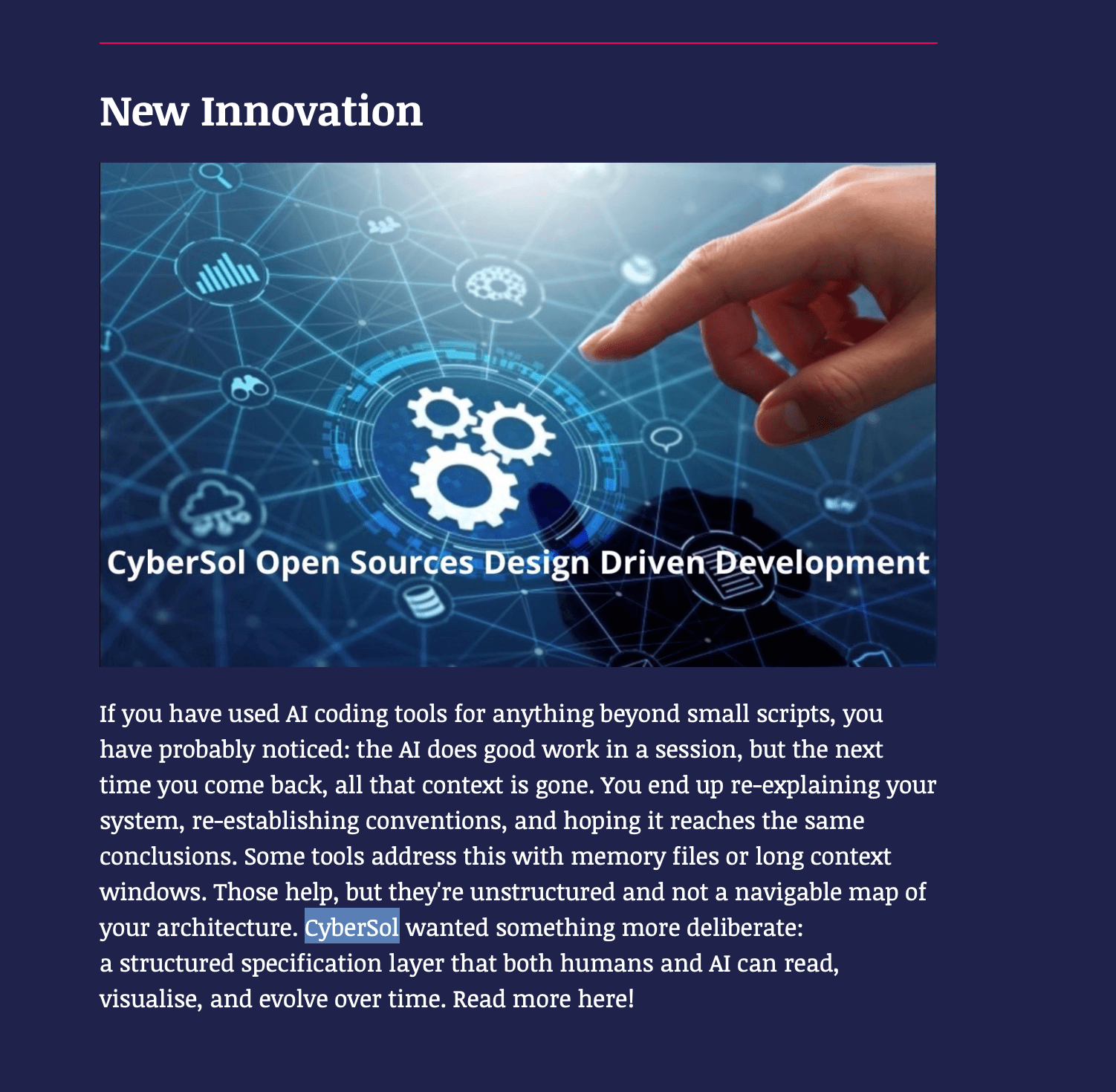
Our OSS project as "New Innovation" in Security Delta's March Security Insight
Security Delta (HSD) — the national security cluster based in The Hague — has featured CyberSol's Design Driven Development (DDD) framework as a "New Innovation" in their March 2026 Security Insight newsletter.
The newsletter is HSD's monthly Knowledge & Innovation Platform publication, covering developments across the Dutch and European cybersecurity ecosystem. This edition includes contributions from Digital Holland, Ministerie van Binnenlandse Zaken, Booz Allen Hamilton, NFIR B.V., Fox-IT, KPN, Cybersprint, and others.
What HSD Recognized
DDD addresses a fundamental gap in AI-assisted software development: context loss between sessions. As the Security Insight piece describes it, developers using AI coding tools find themselves re-explaining their system architecture, re-establishing conventions, and hoping the AI reaches the same conclusions every session.
CyberSol's answer is a structured specification layer that both humans and AI can read, visualize, and evolve over time — not unstructured memory files, but a navigable architectural map that persists across sessions. The DDD framework, desktop tool, and Claude commands are all open source under the MIT license.
Where DDD Stands Today
Since its open-source release on February 20, the framework has shipped 45 versioned releases in 21 days. The most significant development: DDD now analyzes its own shortfall reports, generates evolution plans, and applies improvements to itself after human review.
Key milestones since launch:
- Self-evolution capability —
/ddd-evolvereads shortfall reports from real projects and generates framework improvements - Reverse engineering —
/ddd-reversescans existing codebases and generates complete DDD specifications, with six strategies scaling from small scripts to 500+ file projects - Bidirectional sync —
/ddd-synckeeps specs and code aligned using SHA-256 hashing with behavioral conformance checking - Complete lifecycle — All four phases (Create, Design, Build, Reflect) are now operational
- Desktop application — YAML editing, git integration, drift visualization, and 20+ validation rules
- Enterprise patterns — Agent loop, guardrail, orchestrator, smart router, handoff, and agent group node types for AI-native applications
The command set expanded from 3 to 11, covering the full development lifecycle. The specification model grew from 19 node types to 29, each addition driven by implementation needs from real projects.
Why This Matters for CyberSol
DDD is the foundation of how we build at CyberSol. It's the tool we use to develop our other projects with consistent architectural integrity across AI-assisted sessions. Being recognized by HSD validates the approach — and signals that the problem DDD solves resonates beyond our own development workflow.
We open-sourced DDD because every developer working with AI coding assistants hits the same context wall. The framework is freely available, actively maintained, and evolving with every project that uses it.
What's Next
DDD is one piece of a larger portfolio. CyberSol has additional open-source projects in development, along with OBLIGO — our Cyber Liability Operating System designed to operationalize contractual incident obligations and supply chain risk governance for regulated organizations.
More on that soon.
Links
- Security Insight March 2026: Read the newsletter
- DDD Framework: github.com/cybersoloss/DDD
- DDD Desktop Tool: github.com/cybersoloss/ddd-tool
- DDD Claude Commands: github.com/cybersoloss/claude-commands